




Kenya’s Health Digitisation Is Moving Fast. But Is the System Ready?
Kenya is rapidly transitioning health facilities from the standalone Social Health Authority (SHA) portal to an integrated Health Management Information System (HMIS). The objective is an...

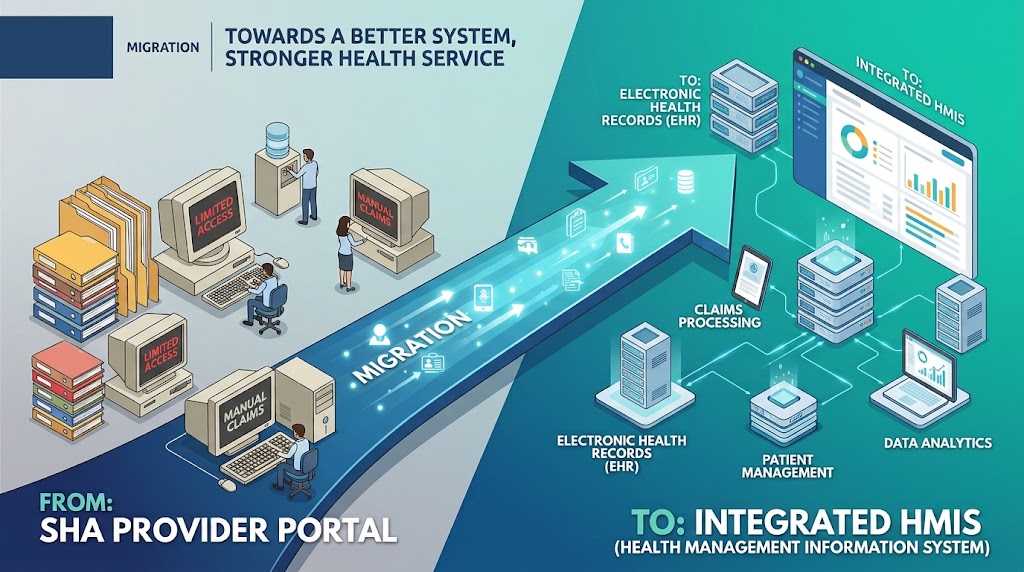
Kenya is rapidly transitioning health facilities from the standalone Social Health Authority (SHA) portal to an integrated Health Management Information System (HMIS). The objective is an interconnected health environment where patient verification, medical records, claims submission, and reimbursements operate within a single digital workflow.
Table Of Content
However, rapid deployment without adequate operational safeguards risks disrupting service delivery and facility cash flows.
1. Facility Onboarding vs. System Complexity
While the Ministry of Health reports that all 6,427 public Level 2 to Level 4 facilities have migrated to the new system, onboarding among larger, more complex institutions remains delayed:
- Level 5 Hospitals: Only four of Kenya’s 27 public Level 5 specialist hospitals completed migration before the transition deadline was extended to October 30.
- Faith-Based Facilities: Only a small fraction of contracted faith-based facilities have finalized the transition.
Level 5 facilities manage high patient volumes, specialized care, and financially significant claims. High onboarding numbers among primary health centers do not reflect total health system readiness if key referral centers are not fully operational on the platform.
2. Digitising Healthcare vs. Digitising Cash Flow
A functional digital health network requires an unbroken operational chain:
$$\text{Patient Arrival} \longrightarrow \text{Identity Verification} \longrightarrow \text{Treatment Logging} \longrightarrow \text{Claim Generation} \longrightarrow \text{Verification} \longrightarrow \text{Approval} \longrightarrow \text{Reimbursement}$$
If system glitches or verification delays break this chain, healthcare providers absorb the un-reimbursed costs while continuing to fund daily operational expenses, payroll, and medical supplies. The ultimate metric of HMIS success is not facility connectivity, but whether valid claims are processed and paid within predictable timelines.
3. Downtime and Contingency Protocols
Unlike commercial services, emergency medical care cannot pause during server downtime or internet connectivity loss. The transition requires clear, public fallback procedures that outline:
- Offline clinical workflows during internet or server outages.
- Standardized paper-to-digital service reconciliation post-restoration.
- Protections ensuring facilities are not penalized for claims recorded during offline emergencies.
4. Health Data Privacy and Audit Trails
Centralizing sensitive medical records improves continuity of care across facilities, but it significantly increases data privacy risks. Regulators and healthcare administrators must establish:
- Role-based access controls ensuring staff only view relevant patient data.
- Comprehensive system logging to detect and audit unauthorized record access.
- Clear protocols governing cross-facility data sharing and breach notifications under national data protection laws.
5. Resource Disparities in Rural and Small Facilities
Hardware, reliable bandwidth, secondary power backups, staff training, and ongoing technical support represent substantial overheads. Rural and lower-tier providers often lack the IT infrastructure of major urban centers. Requiring cash-strapped facilities to absorb these technology costs while navigating historical payment delays threatens their financial viability.
6. Key Operational Metrics for Evaluating Readiness
Evaluating the HMIS transition requires shifting focus from onboarding totals to operational transparency. The public and health stakeholders need visibility into:
- Active Usage: Total facilities actively submitting electronic claims daily via HMIS.
- Claim Pipeline: Real-time rates of approved, pending, rejected, and manually reconciled claims.
- Reimbursement Velocity: Average duration to settle clean claims against the targeted 90-day window.
- System Stability: Frequency and duration of portal downtime across counties.
Looking Ahead
Transitioning to HMIS is essential for modernizing Kenya’s healthcare financing and service delivery. However, speed should not replace thorough testing. The extended transition deadline to October 30 must be used to stress-test system reliability, clarify contingency protocols, enforce data privacy controls, and ensure that digital efficiency leads directly to predictable hospital reimbursements.
Never Miss a Story: Join Our Newsletter


