
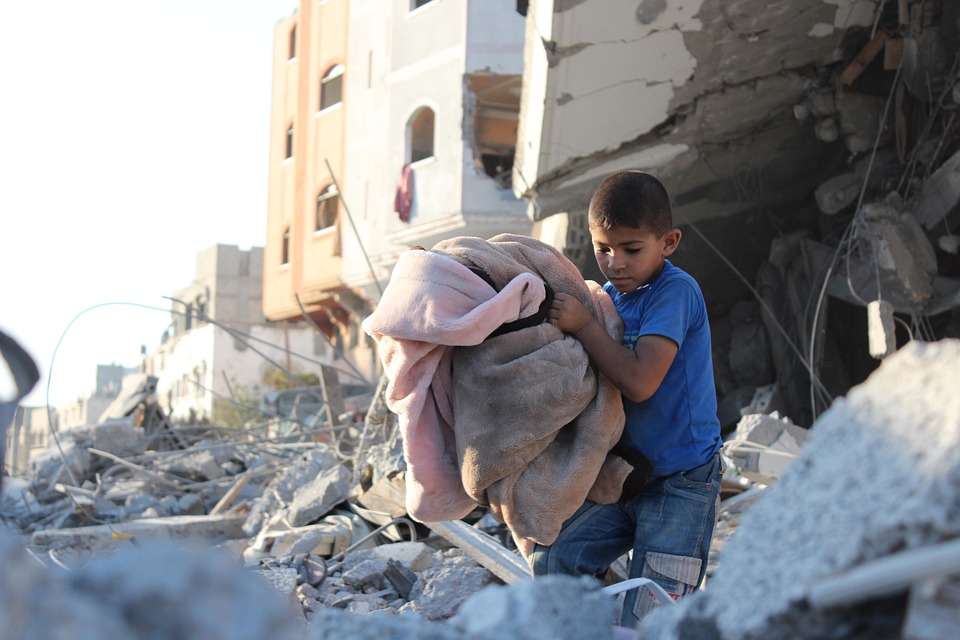
The October 10 ceasefire has done little to unify Gaza. Instead, it has formalised a new geography of control: a so-called “green zone” under the authority of the Israeli military, and a “red zone” where displaced Palestinians are contained with minimal movement. A barely acknowledged “yellow line” separates the two—an invisible border shaping Gaza’s future.
Washington, under President Donald Trump, has indicated that reconstruction efforts will be restricted to the green zone. This is where Israel and its allies have been drafting plans for what they describe as “alternative safe communities”—zones meant to house Palestinians under heavy supervision.
Despite reports last week suggesting the idea had been abandoned, humanitarian workers report that the first such site is still planned for Rafah in the south, with at least 10 more mapped along the yellow line and stretching northwards.
If implemented, these “safe communities” would crystallise a new and dangerous fragmentation of Gaza. Far from being humanitarian spaces, the camps would function as tightly controlled enclaves: Palestinians would be screened before entering, allowed to access services, but denied any return to the sealed-off “red zone,” which remains blockaded and off-limits.
This approach is not new. Years ago, while coordinating UN humanitarian operations in Palestine, I first heard Israeli officials speak of creating “bubbles”—zones where Palestinians would be vetted and only then granted controlled forms of aid. Today’s proposal for alternative communities is simply that idea in its next, more permanent form.
A Ceasefire Without Peace
This is the grim reality of today’s ceasefire. It does not pave the way for peace; it partitions Gaza into smaller and more manageable segments, eroding any hope for Palestinian sovereignty. In effect, it is not a peace plan—it is a piece plan.
Earlier this week, the UN Security Council approved the proposal by voting to establish a “board of peace” to oversee Gaza and an International Stabilisation Force (ISF) to provide security. But with no negotiated agreement in place, the question remains: what exactly will these forces secure? According to maps of the planned “safe communities,” ISF troops would be deployed along the yellow line, effectively guarding the new encampments.
Unsurprisingly, Hamas rejected the resolution. The terms were clearly imposed rather than negotiated. Under point 17 of the Trump plan—attached to the resolution—if Hamas rejects or delays the proposal, the entire project, including expanded aid operations, moves ahead in the so-called “terror-free areas” transferred from the Israeli army to the ISF. This allows these controlled communities to become the only locations where aid is delivered, further tightening the blockade on the rest of Gaza.
The ceasefire’s evacuation logic—used repeatedly over the past two years to force Palestinians from their homes—is being absorbed into an international plan. Those who remain in the “red zone” risk being branded Hamas supporters, stripped of protection under Israel’s contested interpretation of international law, and exposed to continued military strikes.
Meanwhile, humanitarian groups are being pushed out of the decision-making process. A restrictive Israeli registration system is being used to vet or block organisations, curbing their ability to operate and criticise abuses.
A Familiar Colonial Pattern
History is filled with examples of similar schemes.
The British created fortified “new villages” in Malaya in the 1950s.
The United States rolled out “strategic hamlets” in Vietnam in the 1960s.
Rhodesia built “protected villages” in the 1970s.
In all cases, civilian populations were forcibly moved into guarded camps, screened, and made dependent on aid—an attempt to fracture support for resistance movements fighting colonial rule. All of these projects ultimately failed.
Apartheid South Africa’s bantustans—designed to confine and control Black communities—also collapsed along with the regime that created them.
Yet Gaza now faces a similar imposed framework. Instead of dismantling occupation, the plan entrenches it. By endorsing the proposal, the UNSC has effectively legitimised a system that contradicts International Court of Justice rulings on the occupied Palestinian territory—sanitising a landscape marked by devastation and enabling ongoing impunity.
A Precarious Future
Even under a ceasefire, Palestinians are still being killed for crossing invisible boundaries defined by an occupation that remains illegal under international law. While some governments may celebrate the reduction in open fighting—and quietly resume trade with Israel—the underlying structure of violence remains untouched.
A genuine way forward requires accountability—precisely what the US and Israel have avoided. That means implementing the ICJ’s rulings and allowing unrestricted humanitarian assistance across all of Gaza. Reconstruction must be Palestinian-led, not shaped by military logic or foreign political interests.
The dangerous precedent set in Gaza will not remain confined within its new fenced-off zones. It would further weaken what is left of the international “rules-based order.”
Only one principle offers a path out of this crisis: recognising the inalienable right of Palestinians to determine their own future—a right that has been absent from every step of the current plan.
Never Miss a Story: Join Our Newsletter