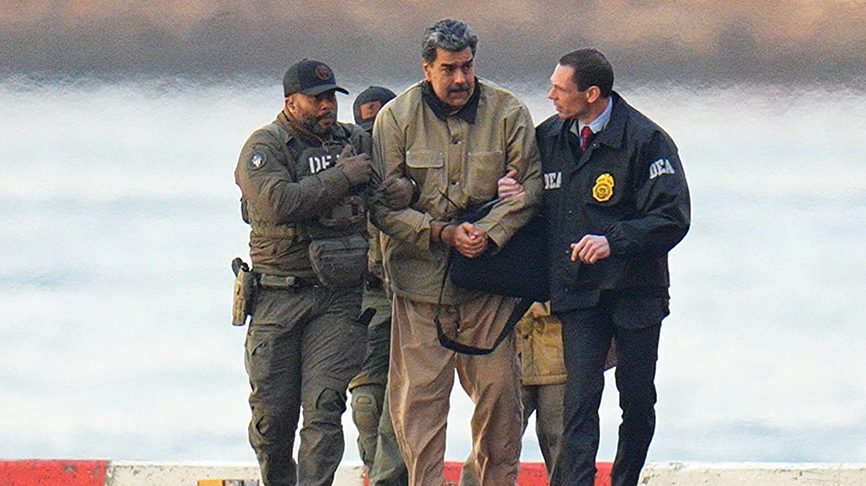
On a dark early morning in January 2026, explosions echoed across Caracas. U.S. military forces struck strategic military bases and governmental nodes, and by dawn, Venezuela’s president, Nicolás Maduro, and his wife had been seized and flown to New York to face U.S. federal charges. The event marked a shock to the world, not just because of its dramatic suddenness, but because it reflected a broader recalibration of international behaviour — one where old rules no longer seem to apply and great powers are openly asserting their interests with unprecedented boldness.
This moment — the audacious U.S. operation in Venezuela — has become a prism through which many analysts now read the state of global politics. From Greenland, where the U.S. president declared that Washington would acquire the Arctic territory “whether they like it or not,” to Eastern Europe, where Russia’s war on Ukraine grinds into its fourth year, this is an age defined by strategic competition, shifting norms, and revived power rivalries.
To understand what is unfolding — and why it matters — we must examine these developments not as isolated flashpoints, but as part of a broader international tectonic shift.
I. A Raid in Caracas: A Break with Post-Cold War Restraint
The U.S. military operation in Venezuela did not happen in a vacuum. It followed months of increasingly confrontational U.S. policy toward Caracas that blended anti-drug rhetoric with energy geopolitics and explicit regime-change goals. A multi-phase campaign that began in 2025 with naval deployments, sanctions and maritime interdictions targeting Venezuelan oil tankers culminated in the direct use of force. The objective, publicly framed in U.S. government statements, was to capture a leader accused of narcoterrorism and bring him to justice on U.S. soil.
Whether one agrees with the legality of this move, there is no doubt it sent shockwaves through capitals around the world. Critics — from South Africa’s foreign ministry to European Union officials — denounced the operation as a blatant violation of international law and a dangerous precedent for how powerful states may now treat sovereignty.
Even some U.S. allies, long comfortable with American global leadership, expressed discomfort. The United Nations’ human rights arm warned that the intervention undermined foundational principles of sovereignty and self-determination. What was once considered taboo — the direct military seizure of a sovereign government’s head of state — happened in broad daylight.
In some quarters, the raid was celebrated as a decisive blow against a regime long blamed for corruption, repression and economic collapse. In others, it was seen as reckless adventurism — a dangerous signal that might encourage similar actions by other powers.
II. Greenland: From Strategic Ally to Strategic Commodity
Barely days after Nicolás Maduro’s capture, the conversation shifted starkly northward when the U.S. president renewed his declaration that the United States would acquire Greenland, an autonomous territory of the Kingdom of Denmark. In what diplomats described as a stunning escalation, he argued that Greenland’s strategic position in the Arctic — with its proximity to Russia, China, and emerging shipping routes — made it essential for U.S. national security.
Despite firm rejection from Greenlandic and Danish leaders — who insist on self-determination and respect for international law — the U.S. posture has sharpened into something more than casual geopolitical interest. The president suggested that if diplomacy failed, other means might be necessary.
What links the Venezuela raid and the Greenland position is not geography but logic. In both, the dominant power is signalling that strategic imperatives outweigh established norms. Caracas was framed as a necessity to disrupt threats in the Western Hemisphere. Greenland is framed as a necessary bulwark against great-power rivals. Whether the U.S. is seriously preparing to invade an ally’s territory remains contested, but the rhetoric alone shifts the Overton window — how far it is considered acceptable for a powerful state to go in pursuit of its interests.
III. The Return of Power Politics
These developments are not merely the product of one administration’s personality or ideology. They reflect a broader transformation in global politics: the resurgence of classic power politics — the notion that states, especially powerful ones, will prioritize control of territory, resources, and strategic position, even at the expense of international norms.
Since the end of the Cold War, global governance institutions and norms — from the UN Charter to trade systems — functioned as constraints on raw ambition. They did not eliminate competition, but they created expectations that sovereignty would be respected and that direct military conquest was off the table. That assumption has weakened dramatically in the last decade.
Russia’s invasion of Ukraine in 2022 was the clearest sign that major powers were willing to use force to achieve territorial and strategic goals once more. What began as a “special military operation” quickly turned into full-scale war, inflicting enormous human suffering and destabilizing the European security architecture that had held since 1945. Despite widespread global condemnation and sanctions, Moscow has shown that even a major power is willing to sustain economic pain to pursue perceived security imperatives.
Meanwhile, China’s posture toward Taiwan, the South China Sea, and broader Indo-Pacific has grown increasingly assertive. Beijing has not launched an invasion, but its diplomatic, economic, and military pressure has steadily increased. Many analysts see China’s strategy as a long game — one that aims to reshape regional architecture and global influence without triggering direct confrontation. (Unlike the U.S. raid on Venezuela, there have been no credible public reports of Chinese military action against Taiwan as of 2026.)
When major powers no longer feel bound by the constraints of a “rules-based order,” each observer begins to look at every incident as a potential test case that might be repeated elsewhere.
IV. A World of Mixed Reactions and Fragmented Norms
The international reaction to these developments has been striking for its fragmentation. In Latin America, responses ranged from enthusiastic support — particularly from right-wing leaders who saw Maduro’s capture as liberation from authoritarian rule — to sharp criticism from countries like Brazil and Mexico, which warned that the precedent could destabilize the region. China and Belarus condemned the U.S. operation for violating sovereignty. Canada and Chile called for respect for international law even as they acknowledged the desire for democratic change in Venezuela.
Europe’s response to the Greenland question has been firm: Greenland is part of Denmark, a NATO member, and its sovereignty cannot be overridden by strategic demands. Danish leaders have warned that U.S. attempts to unilaterally acquire the territory could fracture the transatlantic alliance.
In short, the world’s reaction underscores what has now become obvious to many observers: international norms still exist, but power determines who follows them and under what circumstances.
V. Why These Shifts Matter
Some might dismiss the drama over Venezuela and Greenland as aberrations — eccentricities of one leader or one country. But they are part of a larger systemic shift that is already reshaping global relations:
- Great-Power Competition Returns: After decades of optimism about globalization and international governance, the strategic rivalry among major powers has reasserted itself. Whether in Eastern Europe, the Arctic, or Latin America, powerful states are jockeying for position and advantage.
- Norms Are Under Strain: The rules that have governed interstate conduct — especially the inviolability of sovereignty — are increasingly disputed or selectively applied. When powerful states violate these norms with impunity, it weakens their authority and invites others to challenge them in turn.
- Regional and Middle Powers Are Forced to Adapt: Nations across Africa, Asia, and Latin America are recalibrating their policies in response. Some hedge between competing powers, others assert greater autonomy. None want to be drawn into great-power contests as pawns, but few can avoid being affected by them.
- Multipolar Complexity Deepens: We do not live in a bipolar world like the Cold War, but in a multipolar one where the U.S., China, Russia, and rising regional powers compete simultaneously in different arenas. This complexity reduces predictability and raises the risk of miscalculation.
VI. Prognosis: Navigating an Unsettled World
So where is the world headed?
First, the era of unquestioned post-World War II restraint on territorial conquest appears to be ending. States are more willing to use force — or threaten it — to secure what they define as vital interests. That does not mean open global war; nuclear deterrence and economic interdependence still constrain full-scale conflict among great powers. But local wars with global implications are likely to increase.
Second, international institutions will remain relevant, but their power will depend on cooperation among major states. Where major powers clash or disregard norms, institutions like the United Nations will struggle to enforce compliance.
Third, regions will become increasingly strategic battlegrounds. Africa’s mineral wealth, the Arctic’s shipping and resources, the Indo-Pacific’s maritime routes — all are arenas where competition will intensify.
Finally, domestic politics will increasingly influence foreign policy. Leaders facing internal pressures may find external aggression or high-profile strategic moves attractive to bolster legitimacy, even if risky internationally.
The Price of Power in the 21st Century
The U.S. capture of Nicolás Maduro and the subsequent talk of acquiring Greenland are not anomalies; they are symptoms of a deeper shift in world politics. They remind us that great powers still act on the basis of strategic imperatives, and that when international norms conflict with perceived national interests, power often wins.
This is not the end of international order — but it may be the end of the comfortable belief that order is synonymous with law. Instead, we are entering a period where order is negotiated, contested, and often enforced by those with the ability to project force.
The question for the coming decades is not whether power matters — it always has. The question is whether the world can rebuild norms and institutions that restrain power without suppressing legitimate security concerns, and whether states large and small can navigate a world where sovereignty and strategy are constantly in tension.
Never Miss a Story: Join Our Newsletter