
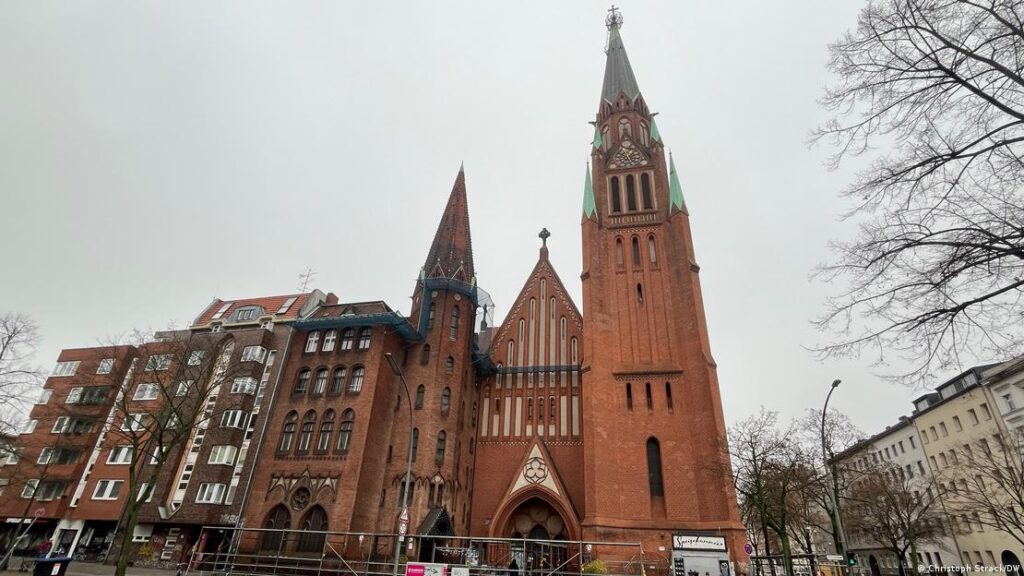
Across Germany, once‑bustling church buildings are falling silent as congregations shrink rapidly due to declining membership. In many communities, centuries‑old houses of worship are being deconsecrated and given new life with entirely different functions — from homes to shops, sports halls to hotels.
Last Service and Emotional Goodbyes
In Gildehaus, near the Dutch border, the small Catholic church of St. Anna’s was filled one last time for its final mass. Choirs and organ music accompanied a congregation saying goodbye. Afterward, parishioners removed sacred relics — tiny fragments of saints traditionally embedded in the altar — making the closure poignantly real. Catholic pastor Hubertus Goldbeck described the moment as deeply emotional for his small parish.
This poignant scene reflects a broader trend across Germany: church communities are shrinking and can no longer sustain the large number of church buildings they once had.
A Rapid Decline in Church Membership
Church membership in Germany has fallen dramatically in recent decades. In 2024 alone, the two major Christian churches — Protestant and Catholic — lost over a million members as people formally left the church or passed away. Today, just over 45% of Germans belong to one of these churches, a steep decline from nearly 69% thirty years ago.
As a result, many churches are being deconsecrated or desacralised — formally taken out of religious use so the buildings can be reused or sold. According to the German Bishops’ Conference, 611 Catholic churches have been closed and decommissioned since 2000, while Protestant authorities estimate another 300–350 closures in the same period.
New Lives for Old Buildings
Once deconsecrated, these church buildings often find unconventional second lives:
- In Jülich, the former Catholic Church
- In Wettringen, an abbey has been transformed into a “soccer church,” where people play football inside.
- In Kleve, a former Protestant church now hosts a boxing arena.
- Former church buildings across the country are also being used as pubs, libraries, bookstores and even hotels — such as a former convent in Düsseldorf converted into a four‑star hotel while keeping a nod to its religious past.
With housing shortages in many German cities, architects are increasingly converting old churches into apartments. Examples include projects in Berlin, Rostock, Trier, Cologne and Wuppertal. One of the earliest large residential conversions was St. Luke’s Church in Essen, deconsecrated in 2008 and later turned into apartments, with the original abstract stained‑glass windows still visible.
Residents and tenants often value the unique spaces. Alexandra Schröder, who lives in the converted St. Luke’s Church, says the location and practicality convinced her to move in. A physiotherapy practice in the building also now serves the neighbourhood, with its director praising the calm feeling inside the former sacred space.
Mixed Feelings in the Community
Not all reactions to these transformations are positive. Long‑time neighbours sometimes lament the absence of church bells or the stopped clocks on former towers.
Church authorities and researchers are studying how former church buildings can continue to serve communities in meaningful ways. For example, art historian Klaus‑Martin Bresgott and architecture students explored how large unused churches could become valuable public spaces in urban neighbourhoods lacking places to gather, play sports or host cultural activities.
Bresgott notes that the role of church buildings has shifted over time: historically they have served secular functions too — even as stables during the Napoleonic Wars — and should not be written off simply because they’re no longer used for worship.
Never Miss a Story: Join Our Newsletter