Yaoundé, Cameroon — October 28, 2025
Cameroon is facing one of its most volatile moments in decades following the declaration of President Paul Biya’s victory in a fiercely contested election. The 92-year-old leader, who has ruled the Central African nation since 1982, was announced winner with 53.66% of the vote in the October 12 poll — a result immediately rejected by his main rival, Issa Tchiroma Bakary, who claims massive irregularities.
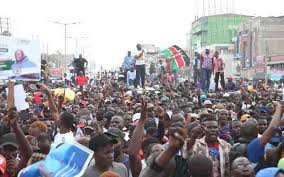
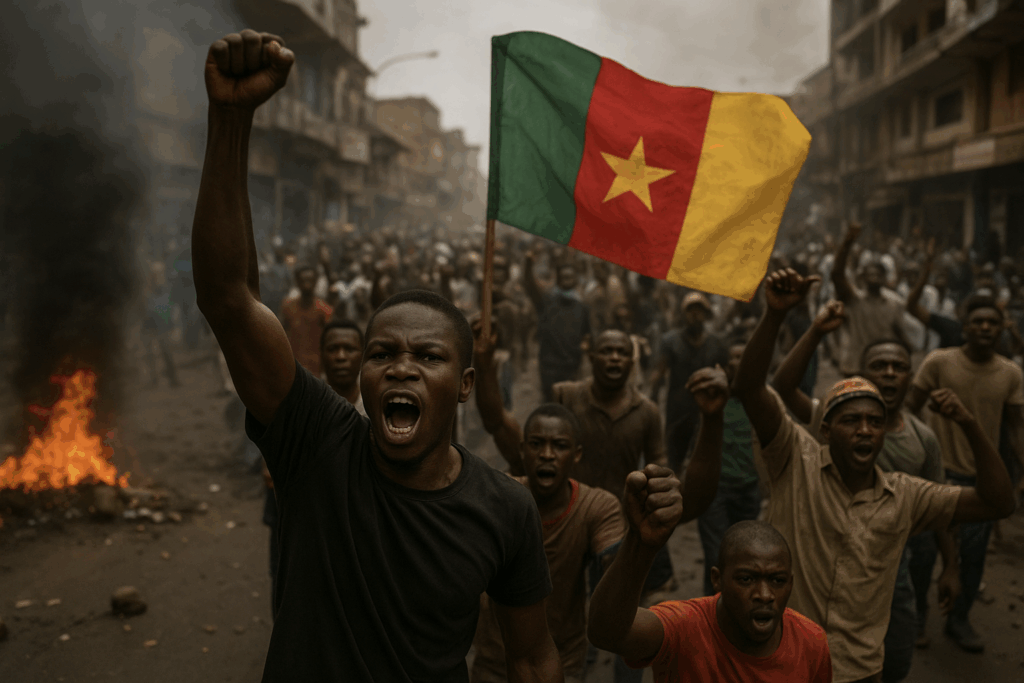
Protests erupted across major cities including Douala, Garoua, and Bamenda, leaving at least four people dead and dozens injured, according to rights monitors and local media. Security forces have deployed heavily, firing tear gas and live rounds in some areas to disperse crowds demanding Biya’s resignation and a re-run of the vote.
A Country Divided
The protests underscore deep divisions in a country already battered by years of conflict, corruption, and mistrust in public institutions. The opposition accuses the ruling Cameroon People’s Democratic Movement (CPDM) of vote rigging, intimidation, and blocking opposition observers from polling stations.
“We will not recognize a stolen victory,” Bakary told supporters at a press briefing in Douala, vowing to continue peaceful demonstrations despite a government ban on public gatherings.
The government, meanwhile, maintains that the election was “free and fair.” Communication Minister René Sadi dismissed the protests as “illegal acts of destabilization,” warning that security forces “will restore order by all necessary means.”
Echoes of the Past
Cameroon’s political landscape has been dominated by Paul Biya for over four decades — making him one of the world’s longest-serving leaders. Known for his reclusive style, Biya has managed to maintain power through a combination of patronage, tight control of the military, and a weakened opposition.
This year’s election, however, has tested his grip on power more than any other. With rising youth unemployment, inflation, and persistent insecurity, frustration among citizens has reached boiling point.
“Many young Cameroonians feel trapped — unable to find jobs, unable to express themselves politically, and disillusioned by decades of stagnation,” said political analyst Dr. Clarisse Ngassa of the University of Douala. “The protests are not just about the election results; they’re about the future of the country.”
Anglophone Crisis Shadows the Vote
The election took place against the backdrop of the long-running Anglophone conflict in Cameroon’s North-West and South-West regions. Since 2017, separatist fighters there have been battling government forces, seeking independence for what they call “Ambazonia.”
Despite government assurances of security, voting was severely restricted in several towns in the Anglophone regions. Many polling stations remained closed, and voter turnout was reported to be as low as 10% in some areas due to fear of attacks.
Human rights groups say both government forces and separatists committed abuses in the lead-up to the vote.
“The people of the North-West and South-West were effectively disenfranchised,” said a representative from Human Rights Watch. “It’s difficult to speak of a national mandate when millions could not safely participate.
Mounting Humanitarian Toll
The political turmoil comes on top of a humanitarian crisis that already affects millions. According to the UN, more than 2 million people are internally displaced, many living in precarious conditions without access to adequate food, healthcare, or education.
In the Far North, insurgent violence linked to Boko Haram continues to displace families, while climate change has worsened drought and food insecurity. Aid agencies warn that the recent unrest could further disrupt relief operations and deepen the crisis.
“Every flare-up in political violence makes it harder for us to reach those in need,” said a spokesperson for Médecins Sans Frontières (MSF). “Civilians are bearing the brunt of a political standoff they have little control over.”
International Reactions
International observers have called for restraint and dialogue. The African Union and the European Union have both urged the Cameroonian government to allow peaceful assembly and to investigate allegations of electoral irregularities.
The United States and France — both key partners of Cameroon — have expressed concern over reports of violence and internet shutdowns. Washington’s statement urged “an inclusive dialogue that respects the will of the people.”
However, Biya’s government has shown little sign of backing down. The Ministry of Territorial Administration has suspended several opposition-aligned civil society groups and threatened to revoke media licenses for “inciting unrest.”
A Tense Road Ahead
As night falls over Douala and Yaoundé, the streets remain tense. Police checkpoints dot the roads, and opposition figures are reportedly under surveillance. Many Cameroonians fear that a harsh crackdown could ignite wider violence, particularly in the already restive Anglophone regions.
“The government can no longer rely on the same old playbook,” said analyst Ngassa. “Cameroon’s young population is more connected, more vocal, and more determined than ever before.”
Whether the ruling elite chooses dialogue over repression will likely determine whether Cameroon enters a new phase of reform — or slides deeper into crisis.
At a Glance: Cameroon’s Crisis
| Issue | Key Details |
|---|---|
| Election date | 12 October 2025 |
| Declared winner | Paul Biya (53.66%) |
| Main opposition | Issa Tchiroma Bakary (35.19%) |
| Protest deaths (so far) | 4 confirmed, dozens injured |
| Conflict zones | Anglophone North-West & South-West; Boko Haram in Far North |
| Internally displaced persons (IDPs) | ~2 million |
| President’s time in power | Since 1982 (8th term) |
Cameroon now stands at a crossroads. The disputed election has peeled back layers of frustration that have long simmered beneath the surface — from political exclusion and corruption to regional inequality and economic hardship. While the immediate spark was the ballot box, the unrest speaks to a deeper crisis of governance and trust.
If President Biya’s government responds with repression instead of reform, the country risks descending into prolonged instability, with devastating consequences for ordinary citizens. But if both the ruling elite and opposition can commit to genuine dialogue, transparency, and decentralization, Cameroon still has a chance to restore its fragile unity and rebuild public confidence.
For now, the nation’s future hangs in the balance — between an aging political order struggling to maintain control and a new generation demanding change, accountability, and a voice in shaping tomorrow’s Cameroon.
Never Miss a Story: Join Our Newsletter