Elon Musk’s Top 5 Stock Picks

Post

Elon Musk’s Top 5 Stock Picks

Elon Musk is widely known not only for leading some of the most innovative companies in the world, but also for his forward-looking investment mindset. His interests tend to align with technologies that redefine industries — from energy and transportation to space, artificial intelligence, and digital finance. Below is an in-depth look at five key assets and companies most closely tied to Musk’s priorities and long-term vision.

Tesla (TSLA)

Tesla remains the centerpiece of Musk’s business and investment world. Beyond electric vehicles, the company is deeply involved in battery innovation, energy storage, robotics, and autonomous driving technology. Musk has repeatedly emphasized that Tesla is as much an AI and energy company as it is an automaker.

With strong global brand recognition and a leadership position in EV technology, Tesla continues to influence the direction of clean mobility and sustainable energy solutions. Its valuation reflects high expectations around future growth in areas such as self-driving systems, humanoid robotics, and energy infrastructure.

SpaceX (Private)

SpaceX represents Musk’s ambition to expand human presence beyond Earth. Through reusable rocket technology and the rapidly growing Starlink satellite internet network, the company has transformed the economics of space travel and global communications.

Although SpaceX is privately held and unavailable to public investors, it remains one of the most valuable private companies in the world and a defining pillar of Musk’s portfolio. Its success in launch services, satellite deployment, and deep-space research reinforces Musk’s long-term mission of interplanetary exploration.

Neuralink (Private)

Neuralink is Musk’s bold exploration into brain–computer interface technology. The company is developing implantable devices designed to help patients with neurological conditions and eventually enable more direct interaction between humans and machines.

While still in early clinical stages and not publicly listed, Neuralink reflects Musk’s belief that humanity must evolve alongside artificial intelligence. The project positions him at the frontier of neurotechnology and raises profound possibilities around medicine, cognition, and human capability in the decades ahead.

Bitcoin (BTC)

Musk has been one of the most influential public figures in the cryptocurrency space. Tesla previously disclosed Bitcoin holdings, and Musk has spoken frequently about digital assets and decentralized finance. His engagement with Bitcoin highlights his interest in alternative financial systems and emerging digital-value networks.

Bitcoin remains highly volatile, but its appeal to Musk lies in its potential as a technological and economic experiment that challenges traditional monetary structures.

NVIDIA (NVDA)

Artificial intelligence is central to many of Musk’s ventures — from autonomous driving to robotics and large-scale computing — and NVIDIA sits at the core of the global AI hardware ecosystem. Its GPUs power data centers, machine-learning systems, and advanced computational platforms used across numerous industries.

Musk has openly acknowledged the importance of high-performance computing to his companies, and NVIDIA’s dominance in AI infrastructure makes it one of the most strategically relevant technology stocks in the modern innovation landscape.

Musk’s key investments and business ties share a common theme: they target transformative technologies with the potential to reshape how people live, move, communicate, and think. Tesla and SpaceX push the boundaries of transportation on Earth and beyond, Neuralink explores the future of the human mind, NVIDIA drives the AI revolution, and Bitcoin represents a new frontier in digital economics.

Together, these picks illustrate an investment philosophy rooted in bold ideas, long time horizons, and industries where innovation can change the course of the future.

Miss Trudy

Miss Trudy: Family, Husband, Age, Tribe, Lifestyle, Net Worth & Full Biography

Miss Trudy (born 10 May 1994) — real name Gertrude Awino Njeri Juma — is a Kenyan YouTube personality, travel and lifestyle vlogger, digital creator, and influencer known for her engaging travel videos, lifestyle content, and storytelling that highlights African experiences to global audiences.

Early Life, Family & Background

Miss Trudy was born on 10 May 1994 in Nairobi, Kenya, to Rafus Ateng Juma and Mercy Wambui. . She grew up as the only girl and the youngest of three siblings, with two brothers. Tragically, her mother died in a fatal accident in September 2009, leaving her father to single‑handedly raise and support the family.

Miss Trudy has often spoken publicly about her father’s unwavering support — including taking care of her schooling and transport to YouTube shoots early in her career. In gratitude, she has built a retirement home for him in the village, fulfilling one of his lifelong dreams.

Read Also: Read Also: Olive Kalekye Burrows Biography: Family, Husband, Age, Tribe, Lifestyle, and Net Worth

Education

She attended Madaraka Primary School and Milimani Primary School in Nairobi, before proceeding to Shiners Girls High School in Nakuru County. After high school, Miss Trudy studied Mass Communication at St. Paul’s University, Limuru, equipping her with foundational media and communication skills.

Career: From Humble Beginnings to YouTube Fame

Miss Trudy’s rise to prominence was not instant — she began creating content at a time when YouTube wasn’t yet widely understood as a revenue platform in Kenya:

  • After graduating, she worked as a brand promotion saleslady in supermarkets and in a research firm earning very modest daily wages.
  • In 2014 she created her YouTube channel, but initially did not earn any money for almost a year while experimenting with video content.
  • Her breakthrough moment came in 2017 when she became one of the first Kenyan YouTubers to document the Standard Gauge Railway ride from Nairobi to Mombasa — a video that went viral and drew major attention.
  • Encouraged by early traction, she diversified into restaurant reviews, travel vlogs, and lifestyle content — often self‑funded, shooting with just a phone camera at first.
  • Over time she built a significant subscriber base (hundreds of thousands of subscribers and millions of views) and became one of East Africa’s most influential female digital creators.

Her YouTube channel focuses on travel adventures, cultural explorations, lifestyle insights, African village life, food and restaurant reviews, and personal experiences — content that resonates widely with audiences across the continent and globally.

Age, Tribe & Identity

As of 2025, Miss Trudy is 31 years old.

Her ethnic identity reflects Kenyan heritage, with roots tied to both Luo and Kikuyu communities — a mix that informs her dynamic cultural perspective. She practices Christianity and often speaks about faith and resilience in interviews.

Personal Life & Marriage

Miss Trudy’s personal life captured public interest when she entered a high‑profile relationship with Ghanaian YouTube star Wode Maya (real name Berthold Kobby Winkler Ackon), himself a prominent travel vlogger and influencer.

  • Husband: She is married to Wode Maya, a Ghanaian YouTuber with a massive global following.
  • The couple married on 10 September 2022 in a traditional ceremony in western Kenya, attended by close family and relatives.
  • Their union strengthened both her personal stability and collaborative influence in the digital creator space.
  • Despite rumours about a possible divorce circulating in 2024, she publicly denied them and remains married.

Read Also: Victoria Rubadiri Biography: Family, Husband, Age, Tribe, Lifestyle, and Net Worth

Lifestyle & Public Persona

Miss Trudy lives a lifestyle that blends travel, content creation, entrepreneurship, and cultural connection:

  • She and her husband travel extensively, documenting experiences across Africa, the USA, Asia, and beyond — often highlighting positive African narratives.
  • Her videos include house tours, travel documentaries, cultural insights, food reviews, and lifestyle content, appealing to audiences seeking both entertainment and informational content.
  • She has become known for her vibrant personality, engaging storytelling, and commitment to uplifting African stories on a global stage.
  • While building her own brand, she maintains a close relationship with family and often publicly acknowledges the sacrifices of her father and siblings.

Achievements & Influence

Miss Trudy stands out as one of Africa’s top female digital creators:

  • She was an early adopter of travel vlogging in Kenya and set trends that later vloggers followed.
  • Her travel and lifestyle videos have been viewed millions of times, inspiring many young creators to pursue digital careers.
  • Through consistent content creation, she has become a role model for aspiring African YouTubers, especially women in digital media.

Earnings & Miss Trudy Net Worth

Miss Trudy’s financial success comes mainly from YouTube monetization, branded partnerships, and business ventures:

  • Early in her YouTube journey she earned modest amounts, such as roughly KSh 10,000 in her first monetized month.
  • She has reported earnings of up to approximately KSh 1,000,000 (~USD $10,000) in a single month during peak performance. .
  • Independent financial analysis estimates her net worth in the range of $165,000–$500,000 (approximately KSh 24–70 million), though exact figures vary by source.
  • Revenue streams include AdSense (YouTube ads), sponsorship deals, paid collaborations, and potentially Airbnb/property income where she hosts travel content segments.

Her financial journey exemplifies how consistency, creativity, and strategic partnerships — notably with Wode Maya — can lead to substantial income growth for content creators from humble beginnings.

Read Also: Larry Madowo: Kenya’s Star Journalist Making Waves Worldwide

Challenges & Public Conversations

Like many public figures, Miss Trudy has faced both praise and criticism:

  • Some public interactions, such as incidents on social media or at venues like airports, have drawn mixed reactions.
  • Rumours and speculation about her personal life occasionally surface, but she addresses them directly through her platforms.
  • Her journey from job insecurity to digital success remains a powerful narrative about perseverance.

Summary: What Makes Miss Trudy Stand Out

  • Full Name: Gertrude Awino Njeri Juma (Miss Trudy)
  • Age: Born 10 May 1994 (31 as of 2025)
  • Birthplace: Nairobi, Kenya
  • Tribe: Mixed Luo and Kikuyu heritage .
  • Education: Mass Communication, St. Paul’s University
  • Profession: YouTuber, travel & lifestyle vlogger, influencer
  • Husband: Married to Ghanaian YouTuber Wode Maya
  • Family: Daughter of Rafus Ateng Juma and late Mercy Wambui; only girl with two brothers
  • Lifestyle: World travel, cultural content, lifestyle and food vlogs
  • Net Worth: Estimated $165,000–$500,000
  • Legacy: One of Africa’s most influential female YouTubers and storytellers

Trevor Ombija: Family, Wife, Age, Tribe, Lifestyle, and Net Worth

Trevor Ombija (born 9 September 1988) is a distinguished Kenyan journalist, broadcast anchor, political commentator, and media personality widely known for his work on Citizen TV’s “Monday Report” and “Day Break.” He is also a successful entrepreneur with ventures in hospitality and communications.

Early Life & Background

Trevor was born on 9 September 1988 in Kisumu County, in the former Nyanza Province of Kenya. He hails from the Luo tribe, a culturally rich and influential community in Kenya with a long tradition of leadership and public engagement.

Very little has been publicly disclosed about his parents’ identities, but available reports indicate his father worked as a teacher in their village, contributing to Trevor’s grounding in education and community values.

Education

Trevor’s formal education began at Anding’o Opanga Secondary School in Nyakach, Kisumu County, where he completed his high school education.

He then joined the University of Nairobi, where he earned a Bachelor of Arts in Journalism and Media Studies (2010–2013). This academic foundation equipped him with the skills to excel in broadcast journalism — a field in which he would soon make his mark.

Read Also: Olive Kalekye Burrows Biography: Family, Husband, Age, Tribe, Lifestyle, and Net Worth

Career Journey

Early Professional Life

Before entering journalism, Trevor worked various jobs, including as a leaf stores clerk at DHL and reportedly as a matatu conductor in Nyakach, where he interacted with many Kenyans on a daily basis — an experience that helped shape his communication skills and understanding of people’s concerns.

Entry Into Media

Trevor’s media journey began in 2012 when he interned at China Global Television Network (CGTN), then known as China Central Television Africa Bureau. This role introduced him to newsroom operations and professional broadcasting.

He then moved to Nation Media Group, where he worked at Nation FM as a radio news anchor before transitioning to NTV in 2014 as a television news anchor and associate producer — roles that helped him develop a confident, authoritative on-screen presence.

Rise at Citizen TV

In 2019, Trevor joined Royal Media Services (RMS), the parent company of Citizen TV, one of Kenya’s leading television networks. At Citizen TV he became a household name as the host of Monday Report, a prime-time programme that gives the public a platform to engage directly with leaders and policymakers. He also co-hosts the popular morning show Day Break, covering politics, business, social news, and current affairs.

His fluency in both English and Dholuo, coupled with strong interviewing and moderating skills, sets him apart as one of the country’s most trusted and engaging journalists.

Age & Identity

As of early 2026, Trevor Ombija is 37 years old.

He identifies as Kenyan and practices Christianity, reflective of his upbringing in Nyanza County.

Family & Personal Life

Father & Parents

Trevor has kept his parents largely out of the public spotlight, but it is noted that his father worked as a teacher, affirming the importance of education in his early home life.

Details about his mother and other family members (siblings, extended relatives) remain private, as he maintains a deliberate separation between his public career and personal background.

Marriage & Wife

For many years, Trevor kept his romantic life private. However, in November 2024, he publicly introduced his wife, Vanice Morwabe, during a public event in Nyakach, Kisumu County. He referred to her affectionately as kipenzi changu (“my beloved”) and acknowledged her support — including how she has helped bankroll parts of his lifestyle. This marked a turning point in a previously private aspect of his life.

Read Also: Victoria Rubadiri Biography: Family, Husband, Age, Tribe, Lifestyle, and Net Worth

Children

Trevor is a proud father. In June 2023, he introduced his son, Trevor Jr. to the world, expressing deep love and a commitment to fatherhood. He has mentioned that he is “done having children,” indicating that his son may be his only child.

Relationship History & Public Heartbreak

Before marrying his current wife, Trevor shared in interviews that he had once been in a 10-year relationship that ultimately ended even after the dowry was paid. He spoke candidly about the heartbreak and the importance of personal growth before entering new relationships.

Lifestyle & Interests

Trevor enjoys a modern, dynamic lifestyle that blends professional success with personal passions. While specific hobbies aren’t widely documented, reports suggest that when he’s off camera he enjoys:

  • Reading and personal development
  • Traveling and exploring new places
  • Engaging in community and social conversations through public forums and televised town hall discussions.

Trevor also drives stylish vehicles — including a Mercedes-Benz — reflecting a taste for quality and comfort consistent with his success.

Business Ventures & Entrepreneurship

Beyond his media career, Trevor is a savvy entrepreneur with investments in multiple ventures:

  • Samaki Samaki Club — a popular seafood restaurant and jazz club located in upmarket Lavington, Nairobi.
  • Crestwood Marketing and Communications Ltd — where he is a senior partner. The firm offers communications, PR, marketing, and media services to government agencies and corporate clients.

These businesses significantly contribute to his income and broaden his influence beyond journalism.

Achievements & Recognition

Trevor Ombija’s work has earned him notable accolades and recognition. Most prominently, in 2020 he was awarded the Head of State Commendation (HSC) by then-President Uhuru Kenyatta, acknowledging his contribution to the media industry.

Salary & Trevor Ombija net worth

While exact salary figures are not officially public, estimates suggest that as a senior anchor at Citizen TV, Trevor earns a monthly salary in the range of KSh 350,000 to KSh 700,000, excluding allowances.

Estimates of his net worth vary widely depending on the source:

  • Some industry sources suggest his net worth is in the region of KSh 40–50 million (approximately USD 300,000–400,000).
  • Other speculative figures — including his business interests — place it at around USD 25 million (approx. KSh 3.9 billion), though such figures should be treated cautiously as unverified estimates.

What is clear is that his media salary combined with entrepreneurial investments has made him one of the more financially successful journalists in Kenya today.

Public Image & Influence

Trevor Ombija is widely respected for his:

  • Clear, articulate presentation style
  • Commitment to public engagement and accountability journalism
  • Ability to moderate political discussions and town halls that give ordinary citizens a voice.

His public introduction of his wife and open celebration of fatherhood have further humanised his public persona, making him relatable to many Kenyans while cementing his influence across media and social platforms.

Summary of Key Facts

  • Full Name: Trevor Ombija
  • Date of Birth / Age: 9 September 1988 (37 years old as of 2025)
  • Tribe: Luo
  • Education: University of Nairobi (BA Journalism & Media Studies)
  • Profession: Journalist, Broadcaster, Entrepreneur
  • Employer: Citizen TV & Ramogi TV (Royal Media Services)
  • Family: Private; father was a teacher; spouse Vanice Morwabe; one son, Trevor Jr.
  • Lifestyle: Upscale, media and business-oriented
  • Net Worth Estimate: Varies (speculative estimates from ~KSh 40 million to ~USD 25 million)

Victoria Rubadiri

Victoria Rubadiri Biography: Family, Husband, Age, Tribe, Lifestyle, and Net Worth

Victoria Rubadiri (born 28 January 1987) is one of Kenya’s most respected journalists and international media personalities, celebrated for her commanding presence on screen, incisive storytelling, and her commitment to telling compelling African stories to global audiences. She currently serves as a correspondent with CNN International, anchoring impactful stories across Connecting Africa and other flagship programmes, cementing her reputation as not just a news presenter but a leading voice in African journalism.

Early Life and Cultural Heritage

Victoria was born in Nairobi, Kenya, into a richly multicultural family. Her mother is of Kalenjin and Maasai descent, while her father is Malawian by nationality. Through her extended lineage, she also has roots that include Kikuyu, Maasai, Seychellois, and Scottish ancestry, giving her a multifaceted cultural identity that reflects the diversity of modern Africa.

She spent the early years of her childhood in Kenya before her family moved to the United States when she was around 10 years old. This cross‑continental upbringing gave her a broader worldview and helped shape her professional outlook on global storytelling.

Victoria reportedly grew up in a Christian home, and her family instilled in her strong values around education, resilience, and service — principles that later informed both her career and her approach to journalism.

Read Also: Olive Kalekye Burrows Biography: Family, Husband, Age, Tribe, Lifestyle, and Net Worth

Education and Formative Years

Victoria’s educational journey began in Kenya, but the move to the U.S. was pivotal. She attended Atlantic City High School in New Jersey before enrolling at Temple University in Philadelphia, Pennsylvania, where she earned a Bachelor’s degree in Broadcast Journalism in 2009. Her studies provided a foundation in media ethics, reporting, and production — building blocks that would underpin her professional achievements.

During her university years, she interned at WMGM – NBC 40 TV as an assignment desk editor, gaining valuable newsroom experience early on. These formative experiences exposed her to the practical demands of television news production, sharpening her skills well before she entered the professional world.

Career Beginnings: From Radio to National TV

Victoria began her media career as early as 2007 while still in the United States, then transitioned to Kenya where her professional trajectory took off. Upon returning to Nairobi after graduation, she started at Capital FM, a leading radio station, where she worked as a business reporter and news presenter. Her ability to combine depth with clarity in reporting quickly distinguished her among her peers.

In 2013, she joined NTV Kenya under the Nation Media Group, working as a news anchor, reporter, and script editor. Here, she co‑anchored the Prime Time Weekend Edition and hosted her own segment, Victoria’s Lounge. Her articulate delivery and polished on‑air presence helped her build a strong fan base.

Rise to Prominence: Citizen TV and National Acclaim

In May 2018, Victoria made a major career move to Citizen TV, part of Royal Media Services, where she was a senior news anchor and reporter. She co‑anchored Sunday Live alongside Jeff Koinange and became a household name for her lucid commentary and rapport with audiences.

During her time at Citizen TV, she also produced compelling human‑interest features, including impactful social issue stories like ‘Wombs of Sorrow’, which spotlighted women affected by cervical cancer — a piece that demonstrated her dedication to journalism that matters.

Read Also: Larry Madowo: Kenya’s Star Journalist Making Waves Worldwide

International Breakthrough: BBC and CNN

Victoria’s career reached international recognition in 2020 when she won the BBC World News Komla Dumor Award — an accolade celebrating journalists with the talent to tell African stories with authenticity, insight, and humanity. As part of the award, she completed advanced training at the BBC Academy in London, working across TV, radio, and digital platforms.

This prestigious award not only affirmed her journalistic excellence but elevated her global profile. Following this achievement, she continued to excel in shaping narratives that foreground African voices and perspectives.

In April 2024, Victoria joined CNN International as part of the news team for Connecting Africa, working from Nairobi to highlight business, policy, and cultural stories pivotal to the continent’s development — marking another significant chapter in her career.

Accolades and Influence

Victoria Rubadiri’s accolades extend beyond the Komla Dumor Award. She is often featured in discussions around media excellence in Africa and is considered a role model for aspiring journalists. Her reporting has covered elections, economic trends, public policy, and human stories that resonate on both regional and international stages.

She has been invited to moderate high‑level panels, including forums on sustainable business and public policy, further expanding her impact beyond traditional news anchoring.

Personal Life: Family, Challenges, and Privacy

Victoria is a devoted mother to her daughter Neema, whom she gave birth to at age 18 while still in high school in the United States. She has openly discussed the challenges of balancing early motherhood with education and career aspirations, framing her journey as one of resilience and determination.

As for Victoria Rubadiri husband or long‑term partner, she has not publicly confirmed a marriage or spouse. Reports and rumours have occasionally linked her romantically to fellow journalist Larry Madowo, but these have never been officially confirmed by Victoria herself or her representatives.

Her commitment to privacy means that details about her daughter’s father are largely unknown; she chooses to keep this aspect of her life out of the public eye.

Lifestyle, Hobbies & Interests

Victoria keeps much of her personal life private, but some insights are available from interviews and public appearances:

  • She enjoys travel and photography, often capturing moments from both professional assignments and personal excursions.
  • She has an interest in cooking and creative pursuits, including art and visual expression.
  • Victoria is known for her fashion sense and poise, often highlighted in public engagements and media appearances.

Her hobbies complement a life lived at the intersection of storytelling, observation, and engagement with the world — traits that feed back into her work as a journalist.

Financial Profile: Salary & Victoria Rubadiri net worth

Victoria’s success has also translated into significant professional compensation:

  • While at Citizen TV, she was reported to earn between Ksh 750,000 and Ksh 900,000 per month, plus allowances for wardrobe and other media‑related expenses.
  • Upon joining CNN International, some reports estimate her monthly salary could be in the range of Ksh 2 million to Ksh 3 million — reflective of her international role and experience.

Various online estimations place her net worth in the millions of Kenyan shillings, with some media sources suggesting figures around Ksh 200 million+ or approximately USD 2–2.3 million depending on assets, earnings, and investments. These numbers should be considered estimates, as personal finances are private and rarely fully disclosed.

Public Image and Influence

Victoria Rubadiri is widely admired not just for her broadcasting skills but for her commitment to depth, integrity, and women’s empowerment. She has mentored young journalists and is a frequent voice in conversations about representation, media ethics, and Africa’s evolving role in global narratives.

Her popularity on social media — with large followings on platforms like Instagram — shows that audiences not only respect her professionally but are invested in her journey and perspectives.

Future Aspirations & Legacy

Victoria has shared aspirations of expanding her impact beyond traditional news roles. She has expressed interest in creating original content, possibly including her own production company or media projects that highlight underreported stories from across Africa, especially those that focus on economic growth, cultural innovation, and social transformation.

She also speaks about the importance of telling authentic African stories on global platforms, bridging local contexts with international audiences — a mission that continues to shape her career at CNN and beyond.

Summary of Key Facts (With Requested Terms)

  • Victoria Rubadiri husband – No publicly confirmed spouse or marriage; she keeps her romantic life private.
  • Victoria Rubadiri tribe – Mixed heritage including Maasai, Kalenjin, Kikuyu, Seychellois, Scottish, and Malawian roots.
  • Victoria Rubadiri daughter – Has one daughter, Neema, born when Victoria was 18.
  • Victoria Rubadiri children – One child.
  • Is Victoria Rubadiri married – Publicly single/never officially confirmed marriage.
  • Victoria Rubadiri father – Her father is Malawian; details about his career and identity are private.
  • Victoria Rubadiri salary – Estimated high‑earning journalist with reports suggesting between Ksh 2–3 million monthly at CNN.
  • Victoria Rubadiri parents – Mother of Kalenjin‑Maasai descent and father Malawian; detailed public information is limited.
  • Victoria Rubadiri net worth – Estimated millions of Kenyan shillings (ranges vary depending on source).

Larry Madowo

Larry Madowo: Kenya’s Star Journalist Making Waves Worldwide

Larry Madowo (born 14 July 1987 in Siaya County, Kenya) is a highly respected international journalist, news anchor, writer, and correspondent known for his insightful reporting across business, politics, technology, and culture. He currently serves as an International Correspondent for CNN International, based in Nairobi, and hosts the network’s acclaimed African Voices Changemakers and Playmakers series, showcasing influential figures shaping Africa’s present and future.

Early Life and Education

Larry was born in Barding village, Siaya County. He faced significant challenges early in life, losing his father at age seven and later becoming an orphan after his mother passed away when he was still young. He grew up with his sister, Liz Madowo, who is now a stylist and fashion blogger.

He attended Usingo and Karapul Primary Schools and later Saint Gabriel’s Seminary in Kisumu, where he initially trained with aspirations of becoming a Catholic priest. However, his passion shifted toward storytelling and journalism.

In 2006, Larry enrolled at Daystar University in Nairobi to study Communication. Due to financial constraints, he briefly dropped out but later returned and graduated with a Bachelor of Arts in Communication in 2014.

In 2019, he was selected as a Knight-Bagehot Fellow in Economics and Business Journalism at Columbia University in New York, where he earned a Master’s in Business and Economics Journalism in 2020. His master’s thesis, focused on Africa’s e-commerce pioneer Jumia, won the Philip Greer Scholarship Award for Financial Writing.

Read Also: Olive Kalekye Burrows Biography: Family, Husband, Age, Tribe, Lifestyle, and Net Worth

Journalism Career

Early Career in Kenya

Larry’s journalism journey began humbly. After a brief stint selling tea and mandazi to support himself, he interned at Bahasha FM in 2007 before joining Kenya Television Network (KTN) as a trainee reporter. At KTN, he helped launch and anchor the country’s first daytime business news programs, KTN Financial Markets Live and KTN Business Today, and pioneered the station’s social media presence.

He later joined NTV Kenya as a business anchor and reporter, hosting shows including PM Live and Money Matters, and was known for engaging coverage of major national events.

In May 2012, Larry moved to CNBC Africa in Johannesburg, where he anchored daily market shows like Open Exchange, Power Lunch, and Closing Bell. He returned to NTV later in 2012 as Technology Editor and anchor, and also hosted the popular youth culture show #TheTrend and the panel-based NTV Sidebar.

International Journalism

Larry’s international profile grew as he freelanced for major global outlets including CNN International, France 24, BBC, and Public Radio International. He wrote a weekly column titled #FrontRow for the Daily Nation and later contributed to the Washington Post’s Global Opinions page.

In 2018, he joined BBC News Africa as Africa Business Editor, leading a team across multiple countries. After completing his fellowship at Columbia University, he served as the North America Correspondent for the BBC in Washington, D.C., where he covered landmark events including the COVID-19 pandemic, the 2020 U.S. Presidential election, and protests following the death of George Floyd.

CNN International

In May 2021, Larry joined CNN International as a Nairobi-based correspondent. He was soon promoted to International Correspondent, delivering in-depth reporting on politics, business, culture, and human stories across Africa and beyond. At CNN, he also presents flagship programs and continues to elevate African voices on global stages.

Advocacy and Impact

Larry is a vocal advocate for press freedom and ethical journalism. His outspokenness on these issues, including criticism of media restrictions in Kenya, has highlighted the challenges journalists face in Africa.

He is also active on social media, with a combined following of millions, and frequently speaks at major global forums on media, technology, and business.

Awards and Recognition

Larry’s contributions have earned wide recognition:

  • Named among the 100 Most Influential Africans by New African Magazine.
  • Designated a Young Global Leader by the World Economic Forum in 2020.
  • Awarded the Philip Greer Scholarship Award for financial journalism at Columbia University.
  • His documentary work has won international media accolades, including at the Association of International Broadcasting Awards.

Personal Life

Larry speaks Swahili, English, Luo, and conversational French, and remains deeply connected to his Kenyan roots while engaging global audiences through his journalism.

Marital Status of Larry Madowo

As of 2026, Larry Madowo is not married and has no publicly confirmed spouse or children. He is known to keep his romantic and personal life relatively private, which has led to ongoing public curiosity about his relationship status.

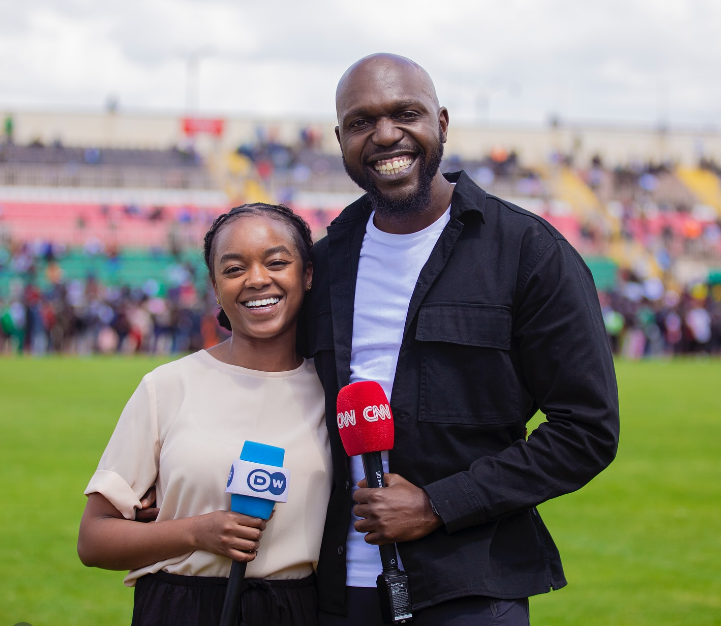
In recent years, Larry has frequently been seen in public and on social media with fellow Kenyan journalist Edith Kimani, a correspondent for DW News. Their interactions—ranging from shared photos and affectionate captions to joint appearances at events—have sparked widespread speculation about a potential romantic relationship. On 14 July 2024, Kimani publicly acknowledged their relationship in a heartfelt birthday post for Larry, describing their bond in personal terms, which many interpreted as confirmation of a romantic partnership.

Despite this public acknowledgment, neither Larry nor Edith has formally discussed plans for marriage. Fans and followers continue to speculate and encourage the couple toward that milestone, but no official announcement has been made regarding an engagement or wedding.

In interviews and social humor, Larry has also playfully addressed questions about whether he is single or married, reinforcing that his personal life remains mostly private while he focuses on his career as an international journalist.

Nicolás Maduro

Why Has Trump Targeted Venezuela?

President Donald Trump has repeatedly blamed Nicolás Maduro for the surge of Venezuelan migrants entering the United States.. Estimates suggest that nearly eight million Venezuelans have fled the country since 2013, driven by economic collapse and political repression. Trump has accused Maduro of “emptying his prisons and insane asylums” and “forcing” inmates to migrate to the U.S., though no independent evidence has substantiated these claims.

In addition to migration concerns, Trump has focused on the flow of drugs—particularly fentanyl and cocaine—into the United States. He has labeled two Venezuelan criminal groups, Tren de Aragua and Cartel de los Soles, as Foreign Terrorist Organizations (FTOs). Trump has even alleged that Maduro leads the Cartel de los Soles himself.

Analysts caution that the Cartel de los Soles is not a hierarchical organization, but rather a term used to describe corrupt officials who allow cocaine to transit through Venezuela. Nonetheless, Trump doubled the reward for information leading to Maduro’s capture and announced plans to designate Maduro’s government as an FTO.

Maduro has vehemently denied any involvement in drug trafficking, accusing the U.S. of using the “war on drugs” as a pretext to seize Venezuela’s vast oil reserves.

What Is the Cartel de los Soles?

The Cartel de los Soles is a loosely defined network of corrupt officials rather than a traditional organized criminal group. While the U.S. has labeled it a terrorist organization, counternarcotic experts argue that Venezuela is primarily a transit country, not a major producer of cocaine. Most cocaine reaching the U.S. originates in Colombia, and the majority of fentanyl enters via Mexico, not Venezuela.

U.S. Pressure on Venezuela

Since Trump began his second term in January 2025, the administration has intensified pressure on Maduro’s government:

  • The reward for information leading to Maduro’s capture was doubled.
  • In September 2025, U.S. forces began targeting vessels allegedly carrying drugs from South America to the U.S.
  • More than 30 strikes have occurred in the Caribbean and Pacific, reportedly killing over 110 people.
  • The administration claims these operations constitute a non-international armed conflict with alleged drug traffickers conducting irregular warfare.

Legal experts have raised concerns. Many argue that the strikes do not target lawful military objectives and constitute a planned, systematic attack against civilians during peacetime. In response, the White House maintains that the operations comply with the laws of armed conflict and aim to prevent cartels from “bringing poison to American shores.”

Additionally:

  • In October 2025, Trump authorized CIA covert operations inside Venezuela.
  • He threatened land strikes against “narco-terrorists”, noting that the first occurred on December 24, targeting a dock used to load vessels allegedly transporting drugs.
  • The U.S. has imposed a total naval blockade on all sanctioned Venezuelan oil tankers, aiming to further weaken Maduro’s revenue streams.

U.S. Military Deployment in the Caribbean

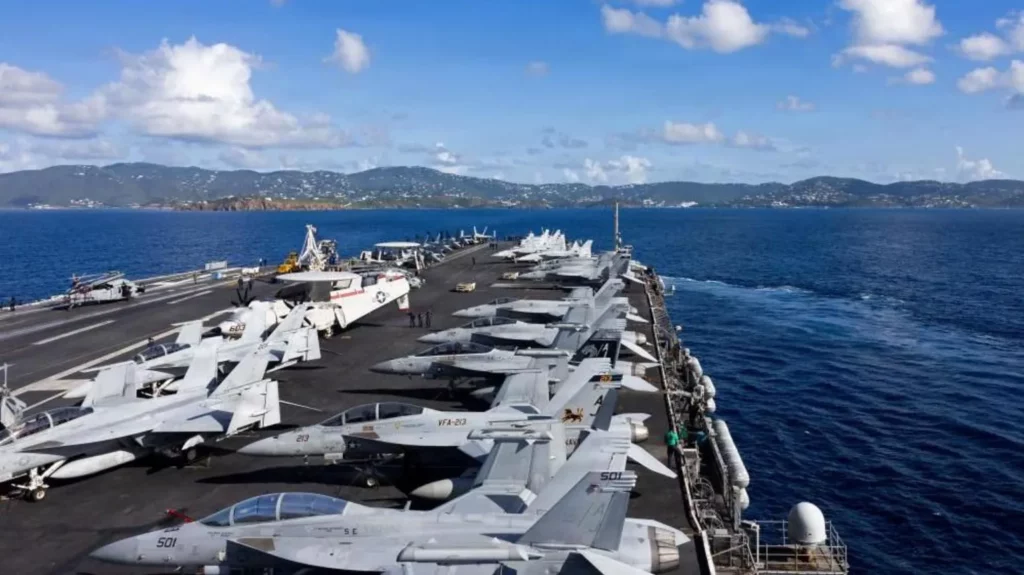
The U.S. has deployed 15,000 troops along with aircraft carriers, destroyers, and amphibious ships, including the USS Gerald R. Ford, the largest aircraft carrier in the world.

Helicopters from the Ford reportedly took part in seizing an oil tanker off Venezuela on December 10, which the U.S. said was transporting sanctioned oil from Venezuela and Iran. Venezuela described the action as “international piracy.” Two more tankers have since been targeted.

Is Venezuela Really Flooding the U.S. With Drugs?

Counternarcotic experts stress that Venezuela is a minor player in global drug trafficking. Cocaine mainly originates in Colombia, while fentanyl production occurs primarily in Mexico, entering the U.S. almost exclusively via land. According to the DEA’s 2025 report, only a small fraction of cocaine reaches the U.S. through Venezuela, most via the Pacific.

Despite Trump’s claims that vessels were “stacked with white powder, mostly fentanyl,” available evidence suggests that Venezuela is not a primary source of the drugs causing the opioid crisis in the U.S.

Maduro’s Rise to Power

Nicolás Maduro came to prominence under Hugo Chávez, a left-wing leader of the United Socialist Party of Venezuela (PSUV). Maduro, a former bus driver and union leader, became president in 2013 after Chávez’s death.

Over the past 26 years, the PSUV has consolidated control over key institutions, including the National Assembly, judiciary, and electoral council.

In 2024, Maduro was declared the winner of a contested presidential election, despite opposition tallies suggesting Edmundo González had won by a landslide. González replaced María Corina Machado on the ballot after she was barred from running. Machado later received the Nobel Peace Prize in 2025 for her efforts toward a peaceful democratic transition.

Venezuela’s Oil and Its Global Significance

Oil is Venezuela’s main source of government revenue, accounting for more than half of its budget. Despite having the world’s largest proven crude oil reserves, mismanagement and sanctions have reduced production.

  • In 2023, Venezuela produced just 0.8% of global crude oil, exporting about 900,000 barrels per day, primarily to China.
  • Maduro has long accused the U.S. of trying to seize Venezuela’s oil, pointing to Trump’s comment after the first tanker seizure: “I assume we’re going to keep the oil.” U.S. officials deny that Maduro’s removal is motivated by oil.

Trump’s targeting of Venezuela combines concerns over migration, drugs, and alleged criminal networks with strategic pressure on Maduro’s oil-dependent government. While Venezuela’s role in the U.S. drug crisis is limited, the administration has justified military action and sanctions as a defense of American lives and economic security.

Meanwhile, Maduro frames the U.S. campaign as a pretext to seize Venezuela’s resources, highlighting the ongoing tension between sovereignty, international law, and geopolitical ambitions in Latin America.

Maduro News

US Invasion of Venezuela: Maduro Captured, Global Reactions, and What It Means for the World Order

On January 3, 2026, the United States launched a dramatic military invasion of Venezuela, striking key sites in Caracas. Reports indicate that President Nicolás Maduro and First Lady Cilia Flores were captured and transported aboard a U.S. warship. President Donald Trump announced that Washington would temporarily “run Venezuela” to facilitate governance and economic transition.

The operation represents the most significant U.S. military intervention in Latin America in decades. Airstrikes struck government buildings, military bases, and communication hubs, while rapid ground operations reportedly minimized civilian casualties.

Global Leaders React

The U.S. action drew immediate international attention and largely negative reactions:

Latin America:

  • Brazil (President Lula): Called it a “serious affront to Venezuela’s sovereignty.”
  • Mexico & Colombia: Criticized the operation; Mexico emphasized regional destabilization, Colombia called it “an assault on sovereignty.”
  • Argentina (President Javier Milei): Celebrated Maduro’s capture as a victory for freedom.

Global Powers:

  • China: Condemned the invasion as “hegemonic acts” violating international law.
  • Russia: Denounced it as “armed aggression.”
  • Iran & Cuba: Strongly condemned the U.S. action, with Cuba labeling it “state terrorism.”

Europe & International Organizations:

  • EU & France: Called for peaceful resolution and adherence to international law.
  • UN (Antonio Guterres): Warned the operation sets a “dangerous precedent.”

Beyond Oil: Understanding the Strategic Calculus

While Venezuela’s massive oil reserves are a factor, the invasion is also about shaping global financial and political architecture. Venezuela had developed alternative economic networks to survive sanctions, including barter agreements, gold-backed trade, and limited cryptocurrency use.

For the U.S., this emergent parallel financial system posed a strategic challenge. If replicated elsewhere, it could erode the effectiveness of sanctions, a cornerstone of Western influence over smaller or mid-sized economies.

Energy Markets and Economic Leverage

Secondary oil producers like Venezuela serve as shock absorbers in volatile energy markets. Control over Venezuela offers leverage over:

  • OPEC+ dynamics
  • Price volatility
  • Strategic energy-transition planning

This demonstrates that the invasion is not just about oil volume but about economic and market influence.

Parallels to Other Unilateral Interventions

The Venezuela intervention is part of a pattern of unilateral military operations by powerful states, often justified by strategic, political, or ideological rationales:

  1. Russia in Ukraine (2022–present):
    • Russia justified its invasion as a security measure and claimed to protect Russian-speaking populations, but international law and the UN deemed it illegal.
    • Global sanctions, military aid to Ukraine, and isolation of Russia illustrate how unilateral action can provoke prolonged international resistance and economic fallout.
  2. U.S. in Iraq (2003):
    • The U.S. invaded citing weapons of mass destruction, later disproven, under a doctrine of preemptive action.
    • The intervention destabilized the region, provoked global debate about legality, and fueled insurgencies, demonstrating the long-term risks of unilateral interventions framed as regime change.
  3. U.S. in Panama (1989):
    • The removal of Manuel Noriega was swift, justified under drug trafficking charges and protection of U.S. citizens.
    • Though operationally successful, it sparked discussion about sovereignty and the threshold for military intervention in another state.
  4. Other Cases:
    • Syria (2014–present, limited U.S. strikes), Kosovo (1999 NATO action), and Libya (2011 NATO-led intervention) each show the tension between military objectives, international legitimacy, and global perception.

Lesson for Venezuela:

  • Like Ukraine and Iraq, the U.S. operation risks regional destabilization and international pushback, even if militarily decisive.
  • Unlike Russia in Ukraine, the U.S. is operating in its “backyard,” where hemispheric politics, OAS protocols, and neighboring state interests add layers of complexity.

By situating Venezuela alongside these examples, the invasion can be seen as part of a broader pattern of great powers using unilateral force to shape political and economic outcomes, while highlighting the delicate balance between operational success and international legitimacy.

Regional and Legal Implications

Latin American nations have long sought strategic autonomy, balancing relations with the U.S., China, and regional partners. The U.S. invasion threatens this autonomy by:

  • Reasserting a security-first paradigm
  • Undermining regional integration and diplomatic initiatives
  • Forcing governments to take sides

Legally, the invasion is controversial:

  • Many argue it violates the UN Charter
  • Critics say it sets a dangerous precedent for future interventions

International norms, once considered protective, are tested when a superpower acts unilaterally, echoing debates from Ukraine, Iraq, and Libya.

Implications for Sanctions and Global Order

The Venezuela case highlights the tension between:

  • Sanctions as a tool of coercive diplomacy
  • Economic sovereignty and parallel financial networks

If Venezuela is successfully reintegrated into Western systems, sanctions are reinforced as credible. If parallel systems survive or evolve, other nations may replicate Venezuela’s strategies, weakening U.S. leverage and reshaping global economic power.

The events of January 3, 2026, mark a turning point in global politics. The U.S. capture of Nicolás Maduro is not only a regional crisis but also a test of the international system’s resilience, the effectiveness of sanctions, and the strategic calculus of energy and finance in a multipolar world.

Venezuela now joins the historical lineage of countries affected by unilateral interventions — from Iraq to Ukraine — offering a critical lens for evaluating power, legality, and long-term global consequences.

This is more than a story of one leader’s removal. It is a battle over economic sovereignty, regional autonomy, and the rules governing great-power conduct in the 21st century.

President Maduro

The United States Invades Venezuela, Captures President Maduro — And the World Is Watching

On January 3, 2026, the United States launched a dramatic military invasion of Venezuela, involving airstrikes against key strategic sites in Caracas and the capture of Venezuelan President Nicolás Maduro and his wife, First Lady Cilia Flores. According to official accounts, Maduro was removed from power in an overnight operation and transported aboard a U.S. warship, while President Donald Trump announced that Washington would “run Venezuela” temporarily to facilitate a transition and overhaul of governance and economic systems.

The rapid escalation marks the most consequential U.S. military intervention in Latin America in decades, reminiscent in scale and ambition of the 1989 invasion of Panama and the early stages of the Iraq War. World leaders ranging from Brazil’s Luiz Inácio Lula da Silva to China and members of the European Union have condemned the operation as a violation of international law and Venezuelan sovereignty, while some Latin American partners emphasize the need for peace and dialogue over unilateral force.

This unprecedented move — widely described as the U.S. invasion of Venezuela — has thrust global attention onto not just the geopolitical consequences, but also the broader structural shifts reshaping international power, economics, and the future of sanctions as a policy tool.

U.S. Invasion of Venezuela: More Than Regime Change

To understand the significance of the U.S. military strike and capture of Maduro, it’s essential to look beyond the surface of conventional narratives — regime change, dictatorship versus democracy, oil interests — and situate the invasion within deeper tectonic shifts in global systems of economic governance.

Yes, Venezuela sits atop the largest proven oil reserves in the world — roughly 303 billion barrels — making it strategically attractive in an era of energy uncertainty and geopolitical competition.

But conflating the invasion solely with oil grabs oversimplifies its implications. To grasp what’s truly at stake, we need to recognize that this invasion may be more about the future of economic sovereignty, the erosion of sanctions as a global enforcement tool, and the struggle over alternative financial networks.

In other words, this is not just about Venezuela oil reserves or the personal fate of one leader. It is also about who gets to define the rules of the 21st-century global economic order.

The Broader Context: Sanctions, Parallel Systems, and US Power

For more than a decade, Venezuela has existed under heavy economic pressure from the United States, including comprehensive sanctions and repeated targeting of the Maduro regime’s access to global finance. Early in this decade, those measures were designed — in part — to force political change by drying up revenue streams tied to oil exports and international loans.

What was less anticipated, however, was how Venezuela improvised its way into new economic circuits — barter agreements with non-Western partners, creative banking work-arounds, and resource-for-credit arrangements that skirted U.S. financial choke points. These networks were imperfect and often expensive, but they worked well enough to keep the economy functioning — an emergent proof-of-concept for sanction-resistant economic activity.

From the perspective of Washington and other capitals reliant on U.S. financial primacy, this was not just a political nuisance; it was a potential precedent — a model that other sanctioned states might emulate to blunt the leverage of Western monetary tools. If nations facing punitive sanctions can develop resilience by integrating alternative clearing systems, non-dollar trade corridors, and bilateral trade networks, the credibility of sanctions as a coercive tool diminishes.

Put simply, what Venezuela demonstrated — out of necessity — was that the global economic order is not as monolithic as once assumed. This invention of parallel financial and trade systems posed a challenge: if other states adopt similar strategies, the United States’ ability to influence global actors through sanctions alone weakens substantially.

In this light, understanding the U.S. invasion of Venezuela also means seeing it as a strategic attempt to prevent Venezuela from becoming the template for a post-sanctions world order — a world where economic sovereignty can exist outside the traditional American and Western financial architecture.

Oil Isn’t Just Oil — It’s Economic Leverage in Transition

Detractors will point to Venezuela’s oil as the obvious motive — and there is no doubt that energy resources remain strategically significant. But in a period of accelerating energy transition, where renewable energy adoption intersects with fossil fuel volatility, the value of securing stable access to oil stocks is not solely about long-term production.

Instead, secondary oil producers like Venezuela are becoming crucial in stabilizing volatile markets, acting as buffers during global supply shocks. Whoever controls that leverage has outsized influence in pricing dynamics, investment flows in the transition, and how swiftly peaker nations adjust to renewable competition.

Thus, securing Venezuela can be seen as an attempt to shape energy market stability — influence that ripples through inflationary expectations, investment in alternative energies, and global strategic relationships.

International Law, Sovereignty, and the New Precedent

One of the most contentious aspects of the U.S. invasion is its legality. Many legal scholars and international leaders argue that the military strike and capture of an incumbent head of state violates the UN Charter and basic norms of sovereignty, especially absent a clear resolution from the United Nations Security Council.

Critics argue that such a precedent emboldens unilateral action by powerful states, at the expense of multilateral frameworks designed to maintain peace and prevent aggression. This concern resonates especially in the global South, where many nations — from Africa to Southeast Asia — view the U.S. invasion of Venezuela as a dangerous precedent of extraterritorial military intervention.

Indeed, political formations in countries like South Africa have already condemned the invasion as “imperial aggression,” calling it an outright violation of international law and a potential threat to global peace and stability.

Viewed through this broader lens, the conflict in Venezuela becomes a test case for whether the post–World War II rules-based order can withstand the pressures of great-power competition and unilateral military assertiveness.

Regional Stability and Latin America’s Strategic Autonomy

Latin America has long sought to chart a path of autonomous regional integration — through mechanisms like Mercosur, Petrocaribe, and other cooperation frameworks — balancing relations with the U.S., China, and regional partners. The U.S. invasion challenges that autonomy by reviving a security-focused paradigm that many hoped had receded in favor of economic integration and diplomacy.

Brazil’s condemnation, Mexico’s call for peace, and European emphasis on multilateral responses all highlight deep regional discomfort with this shift. The invasion risks chilling collaborative projects in energy, migration, and trade that were gaining traction during the past decade.

The Future of Sanctions, Sovereignty, and Global Order

At its core, the U.S. invasion of Venezuela highlights two conflicting visions of world order:

  • One where powerful states enforce compliance through sanctions backed by military might.
  • Another where states explore alternative economic networks that limit coercive leverage and expand sovereignty.

If the former reasserts dominance — by re-integrating Venezuela into Western financial and energy systems — it will signal that sanctions remain an effective tool of foreign policy and that deviations will be countered forcefully. If the latter persists — if Venezuela’s parallel systems survive or evolve — it may inspire other actors to seek autonomy from dominant global circuits.

Either outcome will shape how sanctions are used, how alliances are formed, and how economic sovereignty is defined for decades to come.

A Turning Point in Global Power Dynamics

The dramatic events of January 3, 2026 — the U.S. invasion of Venezuela, airstrikes on Caracas, and capture of President Nicolás Maduro — are undeniably a major geopolitical event. But their deeper significance lies not only in immediate political outcomes, but in the structural contest over economic models, financial sovereignty, and the durability of sanctions as a tool of international influence.

This crisis is not only a battle for control of a nation. It is a battle for the architecture of the global economic order — a conflict whose reverberations will be felt far beyond South America.

Newsly KE
Privacy Overview

This website uses cookies so that we can provide you with the best user experience possible. Cookie information is stored in your browser and performs functions such as recognising you when you return to our website and helping our team to understand which sections of the website you find most interesting and useful. View our privacy policy and terms & conditions here.

×