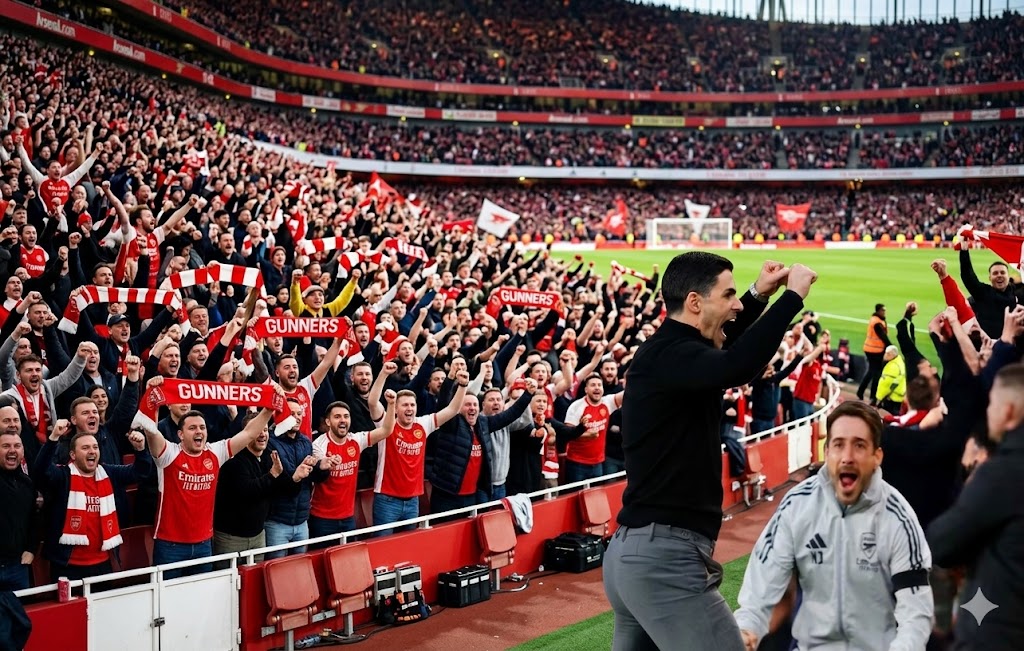
Arsenal have secured their first Premier League title in more than two decades, ending a 22-year drought in English football’s top flight. The title was confirmed after Manchester City failed to beat Bournemouth, making it mathematically impossible for Pep Guardiola’s side to catch Mikel Arteta’s team with a game remaining.
It is Arsenal’s 14th English top-flight championship and their first since the legendary “Invincibles” season of 2003/04 under Arsène Wenger. The victory also reinforces their status as the third-most successful league club in England, behind Manchester United and Liverpool.
A Season Built on Consistency and Control
Unlike previous title pushes, Arsenal’s 2025 campaign was defined not by explosive winning streaks alone, but by sustained consistency across the entire season. Arteta’s side combined defensive discipline with efficient attacking play, creating a balanced team capable of winning in different scenarios.
A standout feature of their season was their effectiveness from set-pieces, with several crucial goals coming from corners and free kicks. This added another layer to their attacking threat, especially in tightly contested matches.
Defensively, Arsenal were among the strongest teams in the league, conceding fewer chances than in previous seasons and maintaining stability even during injury setbacks.
How the Title Was Won
The title was sealed after Manchester City dropped points against Bournemouth, confirming Arsenal as champions before their final match. It ended a tense but controlled title race in which Arsenal rarely relinquished top position during the second half of the season.
Title Race Summary
| Season Stage | Arsenal Position | Key Moment |
|---|---|---|
| Start of season | Top 3 contender | Strong opening run |
| Mid-season | 1st place | Winter consistency surge |
| Spring run-in | Maintained lead | No major collapse |
| Final confirmation | Champions | Man City draw vs Bournemouth |
Learning from Past Near Misses
This title comes after two painful near-misses. In the 2022/23 season, Arsenal led the Premier League for 248 days but were overtaken by Manchester City during the final stretch. In 2023/24, they improved again but narrowly missed out, finishing just two points behind.
Those experiences shaped the squad’s mentality this season. Unlike previous years, Arsenal maintained composure through pressure periods, avoided costly slip-ups, and consistently converted difficult fixtures into points.
Squad Depth and Recruitment Impact
A major factor behind Arsenal’s success was improved squad depth. Strategic recruitment gave Arteta more flexibility across a demanding season involving domestic and European commitments.
New additions strengthened key areas of the pitch, allowing rotation without significant drop in performance levels.
Key Signings Contribution Overview
| Player | Role | Impact |
|---|---|---|
| Eberechi Eze | Attacking midfielder | Creativity in tight games |
| Martin Zubimendi | Midfield control | Stability and ball retention |
| Viktor Gyökeres | Striker | Goals and physical presence |
These additions complemented an already strong core, helping Arsenal compete on multiple fronts without losing momentum in the league.
Arteta’s Long-Term Project Reaches Its Peak
When Mikel Arteta took charge in December 2019, Arsenal were in 10th place and struggling for direction. His early success came quickly with the FA Cup in 2020, but the real transformation required years of restructuring, patience, and belief from the club hierarchy.
There were doubts along the way—about recruitment decisions, tactical choices, and whether Arsenal could truly compete with Manchester City over a full season. However, gradual improvement each year built toward this breakthrough moment.
A Return to Europe’s Elite
In addition to winning the Premier League, Arsenal also reached the UEFA Champions League final for the first time in 20 years, marking a strong return to Europe’s elite level. The combination of domestic and continental success signals a major shift in the club’s trajectory.
Arteta now becomes only the sixth manager in Arsenal history to win a top-flight league title, cementing his place in the club’s modern legacy and ending one of the longest waits in English football history.
Never Miss a Story: Join Our Newsletter