Study Reveals People Who Ghost Others May Feel Worse Than Their Victims Realise
People who suddenly cut off communication without explanation may experience more guilt, sadness and emotional discomfort than the people they leave behind expect, according to new research. Ghosting...

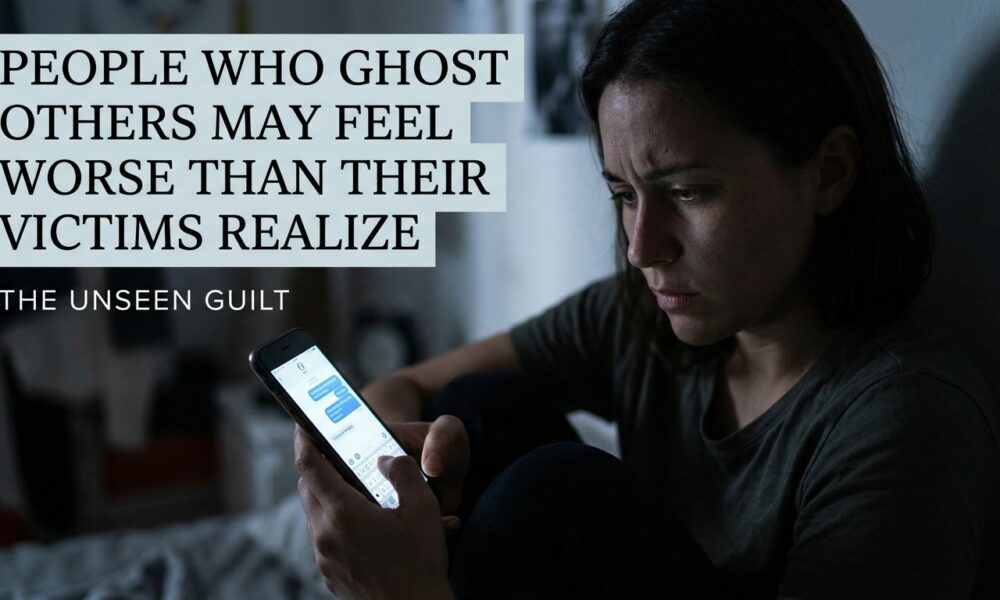
People who suddenly cut off communication without explanation may experience more guilt, sadness and emotional discomfort than the people they leave behind expect, according to new research.
Table Of Content
Ghosting has become a familiar feature of modern relationships, particularly in an era when text messages, dating apps and social media make it easy to communicate — and just as easy to disappear.
But new research suggests that people who stop responding to others may not be as emotionally unaffected as their silence makes them appear.
A study published in Personality and Social Psychology Bulletin found that people who are ghosted tend to underestimate how bad the other person feels about cutting off communication.
The research was conducted by Sophia Li, Coral Zheng and Juliana Schroeder, researchers affiliated with the University of California, Berkeley, and the University of Cambridge.
Their findings challenge the assumption that someone who suddenly disappears from a conversation necessarily feels little or no remorse about their decision.
What Is Ghosting?
Ghosting occurs when a person abruptly stops responding to someone without providing an explanation. It can happen in romantic relationships, friendships and other social interactions.
Someone may ghost a romantic partner after losing interest, stop replying to a friend following a disagreement, or simply leave messages unanswered for an extended period.
In some cases, the silence is deliberate. In others, a person may become distracted, forget to respond or feel uncertain about how to continue a conversation.
Regardless of the reason, the person waiting for a response may interpret the silence as rejection or a sign that the relationship no longer matters.
The researchers sought to understand an overlooked aspect of this experience: how people who ghost others actually feel about their behaviour and whether the people they leave behind understand those feelings.
Three Studies Examined the Emotional Impact
The researchers conducted three studies involving people who recalled real experiences of ghosting, imagined such situations or experienced a simulated interaction in which communication stopped.
In the first study, 195 adults recalled an experience in which they had either ghosted someone or been ghosted. Participants rated their own emotional discomfort and estimated how the other person had felt.
The findings revealed a gap between the two perspectives.
People who had ghosted others reported an average negative-feeling score of 2.27 on a five-point scale. Those who had been ghosted estimated that the people who disappeared had experienced a lower score of 1.56.
The results suggest that people left waiting for a response may assume that the person who stopped communicating feels less troubled than they actually do.
The study also found that people who were ghosted underestimated the guilt and sadness experienced by those who ghosted them.
However, the emotions were not entirely negative. Some people who ended communication also experienced relief, reflecting the complicated feelings that can accompany a difficult social interaction.
Accidental Ghosting Can Be More Complicated
One of the notable findings concerned people who unintentionally failed to respond.
The research suggested that the gap between how ghosters felt and how ghostees perceived their feelings was particularly pronounced when the silence was unintentional.
For example, someone might read a message, intend to respond later and then forget. By the time they remember, the other person may already believe they have been deliberately ignored.
The person waiting for the reply may interpret the silence as indifference, even though the other person feels guilty about failing to respond.
This does not mean that every unanswered message is accidental or that everyone who ghosts another person feels remorse. Rather, the findings indicate that silence alone may not accurately reveal what someone is experiencing emotionally.
Why a Short Message Can Make a Difference
The researchers also examined imagined scenarios involving 601 adults.
Their findings reinforced the observation that people tend to underestimate how bad a person feels about ghosting someone. The researchers further found that this misunderstanding could be reduced when the person communicated briefly instead of disappearing without explanation.
A short message explaining that someone was unavailable to talk could help reduce the uncertainty surrounding the interaction.
This distinction matters because people do not always need to maintain a relationship simply because someone expects a reply. However, communicating a boundary can sometimes prevent unnecessary confusion and emotional distress.
For instance, someone who no longer wishes to continue a romantic relationship could say so clearly rather than leaving the other person to interpret prolonged silence.
A brief explanation may not eliminate disappointment, but it can make the situation easier to understand.
Ghosting Can Hurt Both Sides
Earlier research has also highlighted the emotional consequences of ghosting for the person who disappears.
A 2023 study published in Telematics and Informatics examined ghosting among young people aged 16 to 21. It found that ghosting friends was associated with increased depressive tendencies over time, although ghosting romantic partners did not show the same effect in that study.
Separately, research published in Computers in Human Behavior in November 2025 compared ghosting with explicit rejection. The researchers found that ghosting could produce more persistent negative psychological effects, with uncertainty and the absence of closure potentially making it harder for people to recover emotionally.
Together, these findings suggest that ending communication without explanation can have consequences beyond the immediate interaction.
Nevertheless, the circumstances surrounding each relationship matter. A person may have legitimate reasons to stop communicating, including concerns about personal safety, harassment or unwanted contact. No one is obligated to maintain an unsafe relationship merely to provide closure.
What the Findings Mean for Modern Relationships
As more relationships begin and develop through digital platforms, people increasingly have to interpret silence without the benefit of face-to-face conversations.
A delayed reply does not always mean rejection, while an extended period of silence does not automatically reveal whether someone feels guilty, relieved or indifferent.
The latest findings offer a reminder that people may experience emotions that are not visible to others, even when their behaviour causes disappointment.
For those who have been ghosted, the research does not guarantee that the other person regrets disappearing. Instead, it highlights why assumptions about another person’s feelings may not always be accurate.
For those considering ending a relationship or withdrawing from a conversation, a clear and respectful message may offer a better alternative to leaving someone uncertain — provided that communicating is safe and appropriate.
Ultimately, ghosting is not always a simple story of one person caring and another not caring. Sometimes, both sides experience discomfort, but neither fully understands what the other is feeling.
Never Miss a Story: Join Our Newsletter